
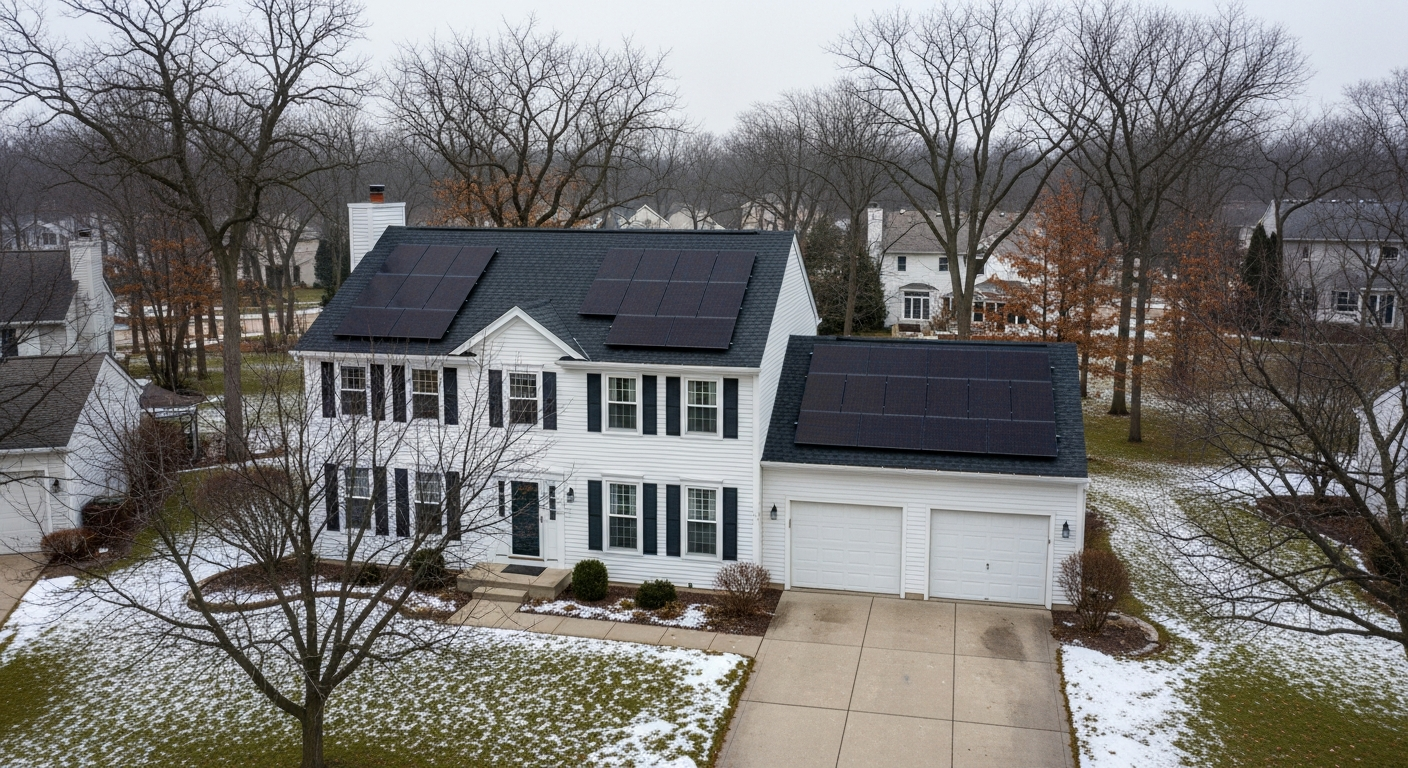
GRAFTON · DIAGNOSTIC
Is rooftop solar worth it in Grafton?
9,200 kWh/year
Annual production
NREL PVWatts v8, 7 kW south-facing system.
~$16,850 to $20,000
Net cash out-of-pocket
After Focus on Energy + Focus on Energy residential solar rebate.
10 to 13 years
Cash payback
No dealer-fee markup, current Customer-Owned Generation Buy-Back Rate rates.
For a lot of Grafton homes the math works clearly, and the household ends up materially better off seven or eight years after install. For others the math takes longer or does not pencil at all, and the point of this page is to tell you which group your home is in before any installer steps onto the roof. If the math works for your home, the proof is in a clean, line-item quote without hidden dealer fees.
The diagnostic walks through real production numbers from federal models, the current We Energies rate, the actual incentive stack after the 2025 federal expiration, and the household conditions that determine whether any of it lands on your side of the ledger.
The case for: typical Ozaukee County numbers
The reference system used throughout this analysis is a 7 kW south-facing array at 20° tilt, close to the median residential system size in Ozaukee County, and the configuration NREL’s PVWatts model uses as its baseline. Numbers below come from the PVWatts v8 API run at the Grafton coordinates (53024), the current We Energies residential tariff, and the Focus on Energy pricing for the current program year.
9,200 kWh/year
Annual production
PVWatts v8, 7 kW south-facing, 20° tilt at Grafton coordinates.
$19,250 to $22,400
Pre-incentive install cost
At $2.80–$3.40/W. Quotes outside this band warrant a second opinion.
~$16,850 to $20,000
Net cash out-of-pocket
After Focus on Energy value and Focus on Energy residential solar rebate, before any financing markup.
~$1,050/year
Annual offset value
Illustrative 50/50 self-consume / export split at current We Energies rates.
10 to 13 years
Cash payback
Cash purchase, no dealer-fee markup, current Customer-Owned Generation Buy-Back Rate rates.
17 to 22 years
Financed payback
Longer once dealer fees (10–30% common, per CFPB) and interest layer in.
Cash vs. financed payback at typical Ozaukee County numbers
Year 0 to Year 25
Cash purchase reaches break-even between Year 10, 13. Financed with dealer-fee markup reaches break-even between Year 17, 22.
Modeled on 7 kW south-facing system, 53024, current We Energies rates and Focus on Energy value for the current program year.
Two things shape how the cash-payback number lands for your home.
First, the 50/50 self-consume / export split is an illustrative assumption. A real household’s share depends on how the system is sized relative to actual annual consumption. Oversize the system relative to the load and a larger share goes to export, which under Customer-Owned Generation Buy-Back Rate is credited at the rate documented in the We Energies tariff: Avoided-cost buyback near 4.2¢/kWh on net exports, not retail. Self-consumption credits at retail rate.. The PSCW filings and current rate documents lay out the supply rate versus delivered rate in detail.
Second, the financed payback figure assumes the loan does not carry an egregious dealer fee. The Consumer Financial Protection Bureau’s August 2024 issue spotlight on solar financing documented dealer fees of 10–30% as common, with some exceeding 50%. A financed quote without the matching cash price disclosed is, in effect, a quote that has hidden the markup. Asking for both prices is the single most effective protection a homeowner has at the quote stage, and it is the first item on Summit’s line-by-line guide to reading a solar quote.
Where the math works clearly, and where to pause and verify
Where the math works clearly
- Monthly We Energies bill consistently runs over $150. Ozaukee County's residential average is $123/mo, and above-average usage is where the offset value compounds fastest. This is the strongest qualifier.
- Roof faces roughly south, has minimal shading, and has at least ten years of life left. South-facing with clear exposure is the production sweet spot; east or west still works with a 10 to 20 percent production trim.
- Plan to stay in the home seven years or longer. Cash payback in this market lands around year seven or eight, and every year after that is direct savings on the household bill.
- Paying cash, using a HELOC, or financing through a clean low-rate loan without dealer-fee markup. The cash price on a clean quote is the real price; ask for it and the path forward is transparent.
- Usage trajectory is going up, EV in the driveway, heat pump on the way, growing family. Size the system for the household two years out, and the offset value scales with the larger bill.
Where to pause and verify
- Monthly electric bill is under $80. The offset value scales with usage, and under this floor the payback math stretches past the useful life of the system. Worth revisiting if usage climbs.
- Roof is predominantly north-facing, heavily shaded by mature trees, or due for replacement within five years. Replace the roof first, then run the numbers again.
- The quote still shows a 30% federal tax credit line item for a 2026 install. That credit ended December 31, 2025; a quote that still includes it is using stale numbers, and that is grounds to ask for a corrected proposal.
For a Grafton homeowner with above-average usage, a south-facing roof, and a seven-or-more year horizon, the math typically pencils clearly at current numbers. The questions below are the ones worth asking before signing, and the marketing claims worth verifying when an installer puts a quote on the table.
Three numbers worth questioning before you sign
Three numbers move the most money on a residential quote, and each has a primary-source answer that is straightforward to verify.
- The federal tax credit on a 2026 cash or loan install. Section 25D terminated for systems placed in service after December 31, 2025, under Public Law 119-21 (commonly called the One Big Beautiful Bill). The IRS confirmed the cutoff in its Residential Clean Energy Credit guidance and elaborated in a dedicated FAQ on P.L. 119-21 . Section 48E still applies to third-party-owned systems (PPAs and leases), where the credit belongs to the system owner, not the homeowner.
- The cash $/W alongside the financed monthly payment. The cash price and the financed price belong side by side; the difference is the dealer fee. Per the CFPB spotlight, that difference is commonly 10–30% of the system price and sometimes more than half. Asking for both at the quote stage is the single most effective protection a homeowner has, and a clean quote will show both without pushback.
- What the bill actually does after installation. A well-sized system offsets a meaningful share of the bill, not all of it. The Federal Trade Commission flagged the "bill goes to zero" framing as the single most common deceptive practice in residential solar in its September 2024 consumer alert . Utility connection fees, undersized hours, and seasonal swing all keep showing up on the statement. The honest expectation is a substantial reduction, not an elimination.
A note on installer failure risk
“Some consumers have reported being told they would receive a federal tax credit equal to 26% of the cost of the system, only to find out later that they were ineligible for the credit, leaving them holding loan balances they cannot afford to repay.”
The Grafton homeowner who signs a 25-year loan for a system is making a bet not just on the panels but on the company servicing the install for that long. Common practice in the residential solar industry over the past several years has been heavy reliance on door-to-door sales models, third-party financing with embedded dealer fees, and warranty obligations that vanish when the company does.
The Pink Energy collapse in October 2022 stranded an estimated 25,000 to 50,000 customers nationwide with active loan balances and stuck systems. None of this is hypothetical. The federal response, a joint Treasury / CFPB / FTC announcement in August 2024 and an eight-state AG action against five solar lenders.
The FTC Holder Rule is the legal mechanism some affected homeowners have used to push the loan-payment obligation back to the financing company when the installer failed. Knowing the term before signing the paperwork is worth more than a written production guarantee from a company nobody has heard of, and is one of several patterns covered in Summit’s longer treatment of the quote questions worth asking before signing.
Run your own number
The fastest non-commercial sanity check is NREL’s PVWatts public calculator . Enter the Grafton ZIP (53024), a system size in the 6–8 kW range, the orientation and tilt of the actual roof plane, and PVWatts returns a monthly and annual production estimate built on the same NSRDB irradiance data NREL uses for its research models. Multiply the annual kWh figure by the current We Energies delivered rate to get a rough offset value; compare against the cash price of a real quote to estimate payback without anyone’s thumb on the scale.
Three inputs matter more than the rest: system size in kilowatts, tilt angle, and azimuth (the compass direction the array faces). Everything else is secondary.
QUICK ESTIMATE
Run the rough math for your home
Enter your ZIP and current bill to see how the math runs for your home.
0 kW
System size
Rough fit for the bill you entered.
0 kWh
Annual production
NREL state-level average for the ZIP.
0 years
Cash payback
After state incentives, before federal.
Estimate only. Real numbers require a site-specific assessment and a quote priced both as cash and as financed. See methodology.
Want a number specific to your home?
The estimate above uses state-level averages. Upload your actual electric bill and Summit will run the math against your real usage, your real rate, and your specific ZIP, then send back a one-page summary within two business days.
Free. No installer handoff unless you ask for one. Start with the math.
What to do next
The diagnostic above tells you whether solar is worth a closer look at your specific roof. Confirming the answer requires the actual roof, orientation, tilt, shade pattern, electrical panel capacity, and a real quote priced both as cash and as financed. The fastest path there is a single quote from a vetted installer serving the area.
The two-minute diagnostic gets you matched with one vetted local installer for a focused comparison. The advisory option has a Summit researcher look at the specific home before any installer is involved, on the household's side of the table.
Sources
- NREL PVWatts API v8 · production estimate, 7 kW south-facing at Grafton coordinates.
- Focus on Energy (Wisconsin's statewide energy efficiency and renewables program), Focus on Energy · Focus on Energy value for residential systems.
- Public Service Commission of Wisconsin (PSCW) · We Energies tariff and net-metering filings.
- Wisconsin PSC consumer protection division · Wisconsin stranded-customer resource.
- IRS, Residential Clean Energy Credit and P.L. 119-21 FAQ · Section 25D termination after December 31, 2025.
- CFPB, Issue Spotlight: Solar Financing · dealer-fee prevalence, 10–30% range.
- Treasury / CFPB / FTC joint announcement · residential solar consumer protections, August 2024.
- FTC, Solar energy is rising in popularity. So are the scams.
- Michigan AG, eight-state action against Pink Energy lenders .
- FindEnergy, Ozaukee County, Wisconsin average residential bill · derived from EIA-861.
Verified · Numbers and program terms change. Verify any figure against the cited source before relying on it.